
Hops are the flowers which are also called seed cones or strobiles of the hop plant Humulus lupulus, it’s a member of the Cannabaceae family of flowering plants. Hops are used primarily as a bittering, flavouring, and stability agent in beer, to which, in addition to bitterness, they impart floral, fruity, or citrus flavours and aromas. The hops plants have separate female and male plants, and only female plants are used for commercial production. The hop plant is a vigorous, climbing, herbaceous perennial, usually trained to grow up strings in a field called a hopfield, hop garden, or hop yard when grown commercially. Many different varieties of hops are grown by farmers around the world, with different types used for particular styles of beer.
So lets talk about the inside the hop flower aka the cone. A yellow powder called lupulin powder, which contains the key compounds that bring flavor to beer like its resin and essential oils. In hop resin you’ll find alpha acids (Probably the most important chemical compound within hops are the alpha acids or humulones. During wort boiling, the humulones are thermally isomerized into iso-alpha acids or isohumulones, which are responsible for the bitter taste of beer.), which in natural form won’t dissolve in wort and aren’t very bitter. It takes the heat and agitation of the brewer’s boil to transform them into bitter iso-alpha acids. When brewers use hops for bitterness, they are typically added at the beginning of the boil and are referred to as “bittering hops.” Outside of bitterness, every other hop trait in beer (like aroma and flavor) come from the oils found in the lupulin gland. Hop oils typically constitute less than 2% of the weight of dry hops, and yet they contribute substantial flavor to the beer. When you leave hops in for an extended time during a boil, most of the hop oils evaporate – this is why brewers add “flavor hops” roughly 30 minutes before the end of the boil and “aroma hops” roughly 10 minutes before the end, instead of adding them all right at the beginning.
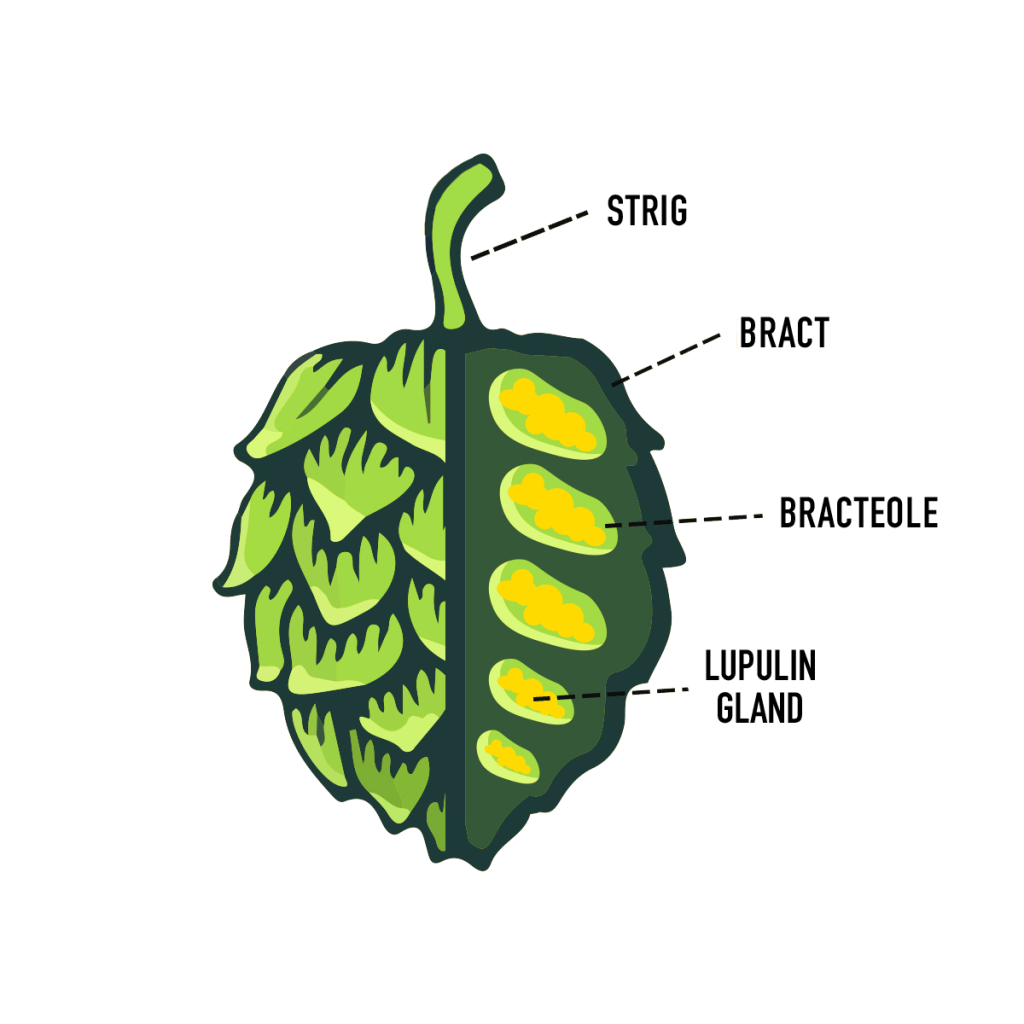
The hop structure terms:
Strig: the footstalk of a leaf or flower.
Bract: the reduced leaf found at the base of the pedicel
Bracteole: the leaf-like structure situated between the bract and the flower.
Lupulin Gland: the yellow gland of a hop plant in which the hop acids and the essential oils can be found. It’s a fine yellow powder that can be separated out from the green leaves of the hop itself, sort of like pollen from a flower.
 BEER PORN MAGAZINE